



In 2019, a Dubai-based technology firm made a massive bet. They poured an estimated $15 million into developing “SalamWeb,” a browser designed to create a “Halal” internet ecosystem for Muslims.
The vision was perfect. The market was hungry. With 1.8 billion Muslims globally facing an onslaught of harmful content, ads, and tracking, the demand for a safe, ethical browser was—and still is—undeniable.
Yet, just two years later, SalamWeb was a ghost town. The domain stopped working, the updates ceased, and millions of users silently migrated back to Google Chrome.
What went wrong?
It wasn’t a lack of demand. It wasn’t a lack of funding. It was a failure of technology. SalamWeb, like many “Halal” tech products before it, fell into the “Wrapper Trap.” They slapped a coat of paint on a broken engine and called it a new car.
At Kahf, we studied this failure obsessively. We realized that you cannot protect users from the dangers of the modern web using the same tools that created those dangers. To build a truly private, Halal browser, you need Deep Tech, not just a wrapper.
Here is the anatomy of a $15 million failure, and why the future of the Islamic Digital Economy depends on learning from it.
Disclosure: Kahf Browser is developed by the author’s company, Kahf Yazılım A.Ş..
The “Wrapper” Trap
Building a web browser from scratch is impossibly expensive. So, most companies use Chromium, the open-source code behind Google Chrome. This isn’t inherently bad—Edge, Brave, and Opera all use it.
However, there is a lazy way to use Chromium, known as building a “Wrapper.” A wrapper is essentially a skin. The developer takes the standard Chrome code, changes the logo, adds a few bookmarks, and maybe installs a basic extension to block some keywords. But underneath, the engine is identical.
Fatal Flaws of Wrappers
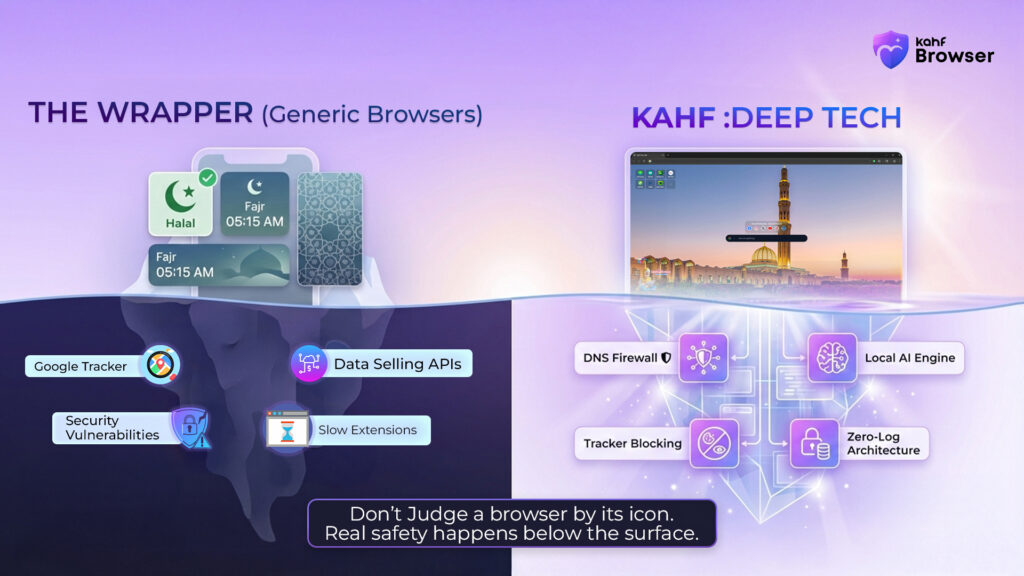
Shared Vulnerabilities: If the underlying Chrome engine tracks your location or allows “fingerprinting,” the wrapper does too.
Performance Drag: SalamWeb was notorious for being slow. Heavy, poorly coded filtering extensions kill speed.
The “Man-in-the-Middle” Risk: To filter content, SalamWeb inspected traffic, triggering Certificate Authority warnings. This breaks secure HTTPS connections, like banking sites.
Users realized their “Halal” browser was just a slower, buggy version of Chrome.
The Data Betrayal: The Other Scandal Effect
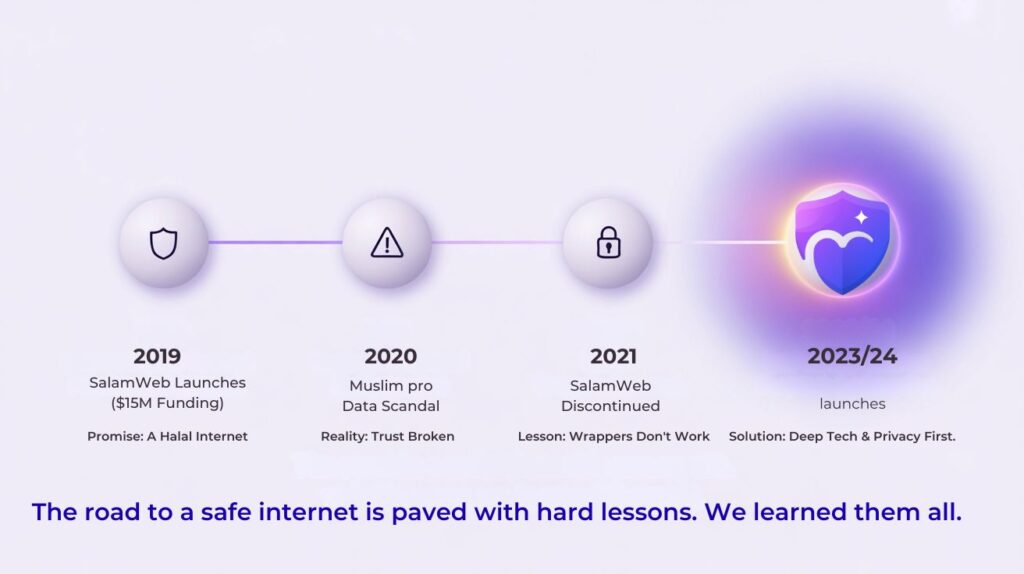
While SalamWeb was struggling with technical debt, the broader Islamic app market suffered a catastrophic breach of trust in 2020.
Muslim Pro, the world’s most popular prayer app with over 98 million downloads, was caught in a data scandal. Reports revealed that the app was selling granular user location data to third-party brokers (like X-Mode), who in turn sold that data to contractors linked to the U.S. military.
The community was outraged.
- “I downloaded this to remind me to pray, and you sold my location?”
- “Is nothing sacred?”
This scandal created the “Ms. Taqwa” Persona we see today: a user who is deeply practicing but deeply skeptical. She wants to protect her eyes from fitnah (harmful content) and her family from vice, but she is terrified of being exploited.
She realized a hard truth: If a product is free, and it doesn’t have a clear business model, YOU are the product.
Most “Halal” apps rely on ads. To make money from ads, they need your data. It is a cycle that fundamentally contradicts the Islamic value of Amanah (trust).
Kahf’s Approach: Deep Tech vs. Cosmetic Skimming
When we built Kahf Browser, we knew we couldn’t just build another wrapper. We had to rebuild the browsing experience from the ground up to solve the security and privacy issues that killed SalamWeb.
We adopted a Deep Tech strategy focusing on two invisible layers of protection.
Layer 1: DNS Filtering (The Bouncer)
Instead of a heavy extension that reads your screen (and slows your phone), Kahf protects you at the DNS (Domain Name System) level.
Think of DNS as the phonebook of the internet. When you type “facebook.com,” your phone asks a DNS server for the IP address.
- Standard Browser: The DNS resolves the address, even if it’s a gambling site or an adult portal.
- Kahf Browser: Our secure DNS checks the request against a massive database of 2.5 million+ harmful domains. If the site is Haram (adult content, gambling, malware), the DNS simply refuses to connect.
- The Benefit: The harmful data never even touches your phone. It saves battery, data, and protects your eyes instantly.
- The Privacy: Because this happens at the connection level, we don’t need to read your screen or track your clicks.
Layer 2: On-Device AI (The Guard)
DNS can block bad websites, but what about bad images on a good website (like a news article or Twitter)?
This is where SalamWeb failed—they tried to filter everything in the cloud, which is slow and invades privacy.
Kahf uses On-Device AI.
- Our lightweight AI model lives inside your app.
- It scans images and text in real-time on your screen.
- If it detects nudity or harmful content, it blurs it instantly.
- Crucial Point: This processing happens on your phone. No images are sent to our servers. No human sees what you are browsing.
This is the difference between a “Wrapper” and “Deep Tech.” One is a sticker; the other is a shield.
Feature Showdown: Chrome vs. SalamWeb vs. Kahf
To visualize why the technology matters, look at this comparison:
| Feature | Google Chrome | SalamWeb (Defunct) | Kahf Browser |
| Core Engine | Chromium | Chromium Wrapper | Chromium + Deep Tech |
| Ad Blocking | Minimal (Supports Ads) | Extension-based (Slow) | Native Ad-Blocker |
| Haram Filtering | None (Requires 3rd party) | “Man-in-the-Middle” | DNS Layer + On-Device AI |
| User Tracking | High (Google Account) | Unclear (Data collection) | Zero-Tracking Policy |
| Speed | Fast | Slow (Bloatware) | Fast (Blocks bloat) |
| Data Business | Ad Revenue | Ad Revenue | Premium Features |
Conclusion: The Future is Private
The $15 million failure of SalamWeb was a painful but necessary lesson for the Islamic Digital Economy. It taught us that values alone are not enough.
You cannot build a “Halal” house on the foundation of “Haram” surveillance capitalism.
For the Ms. Taqwa who fears for her spiritual well-being, and for the Mr. Guardian trying to protect his children from the horrors of the unfiltered web, “good enough” is no longer acceptable.
You deserve a browser that doesn’t just claim to be Halal, but proves it with code. A browser that speeds up your phone by blocking the junk, protects your privacy by keeping AI local, and respects your Amanah by never selling your data.
That is why we built Kahf.
Ready to browse without the baggage?
Download Kahf Browser for Free and experience the internet as it should be: clean, fast, and safe.
References
- [1.1] SalamWeb Status: Discontinued Chromium-based browser (2021). Wikipedia.
- [1.2] “Dubai company to put up $15 mln to develop ‘Shariah-compliant’ web browser,” Salaam Gateway, Feb 2019.
- [3.1] SecureW2, “Reduce the Risks of a Certificate Authority” (Contextual security risk regarding MITM inspection).
- [4.1] “Muslim Pro User Data Scandal – A Betrayal,” Muslim Ad Network, Dec 2020.